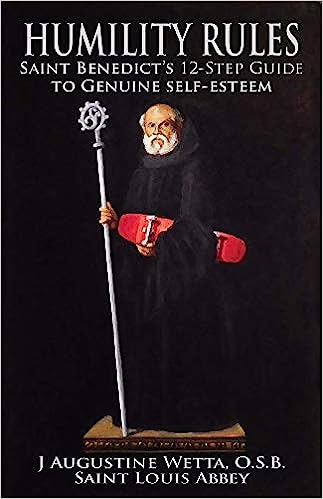

Humility Rules
It was an Episcopalian priest’s sermon about humility that was the tipping point for my faith., more accurately, loss of it. Walking away from that sermon, all I could think was, “I don’t want to be humble but wise. I want wisdom!”
Only to learn, far too many years later, it’s the prerequisite. Without humility, wisdom will not find us.
I was seventeen, confident that I knew exactly what I was doing. I doubt I’ve ever been that certain again.
In a little over two weeks, Lent begins. Fittingly, Saint Benedict’s Daily Rule readings for this past week have been Chapter 7: On Humility.
The first degree of humility, then,
is that a person keep the fear of God before his eyes
and beware of ever forgetting it.
Let him be ever mindful of all that God has commanded;
let his thoughts constantly recur
to the hell-fire which will burn for their sins
those who despise God,
and to the life everlasting which is prepared
for those who fear Him.
Let him keep himself at every moment from sins and vices,
whether of the mind, the tongue, the hands, the feet,
or the self-will,
and check also the desires of the flesh.
The vocabulary of faith is just that: a vocabulary. A ‘linguist of prayer’ is useful, maybe essential. And so Brother Jerome Leo, even in death, remains my mentor for the seventy-three chapter Rule of Benedict we Oblates read three times each year. His meditations are quirky, incisive, and reverent:
Here’s Brother Jerome Leo’s meditation on the first step of humility:
Wow! Fearing God and hell-fire! It’s a safe bet that this chapter was not the darling of the 1970’s and beyond! But, if we look at it properly, there’s nothing to get upset about here.
God is perfect Unity, He is totally of a whole. He is all He is at once and utterly. Human beings, on the other hand, have minds that are finite and cannot wrap their intellects around such a perfectly holistic God without problems. One of those problems is what seem to us to be contradictions in God: His total, absolute Justice and His unfathomable, infinite Divine Mercy. Since we have a hard time figuring out both at once, we have a tendency to let one cancel out the other. God, to many, is either ALL hell-fire and dread or ALL pushover and cuddly. That is not the case!
Rereading four years later
Why read or reread a book about a long-dead saint? In this case, Saint Benedict of Nursia.
About a billion and three reasons, but I’ll limit myself to just a few.
Benedict lived during a time just like our own. Saint Gregory the Great writes:
THERE was a man of venerable life, Benedict by name and grace, who from the time of his very childhood carried the heart of an old man…..He was born in the province of Nursia of honourable parentage and sent to Rome to study the liberal sciences. But when he saw there many through the uneven paths of vice run headlong to their own ruin, he drew back his foot, but new-set in the world, lest, in the search of human knowledge, he might also fall into the same dangerous precipice. Contemning therefore learning and studies and abandoning his father’s house and goods, he desired only to please God in a virtuous life. Therefore he departed skilfully ignorant and wisely unlearned.
That paragraph warrants a pause, “Condemning learning and studies….desiring only to please God….he departed skillfully ignorant and wisely unlearned.“
It’s a pause that should compel us to consider the dangers of our knowledge-obsessed culture, and the propaganda disguised as education that’s peddled to our young.
In the book I reread, four years later, Humility Rules: St Benedict’s Guide to Genuine Self-Esteem by a Benedictine monk named Fr. Augustine Wetta. Father Wetta serves as another ‘linguist for prayer.’ Like Brother Jerome Leo, Father Wetta is quirky, incisive, and reverent.
Here’s Fr. Augustine’s engaging interpretation of Gregory the Great’s The Life of Our Most Holy Father
“Right around the beginning of the sixth century, there lived a teenager who was bored with school. He was at the top of his class. His father was wealthy and influential. This was a smart, charismatic kid, and he seemed destined for greatness.
But he hated school. It wasn’t that he had anything against learning; he just felt like he was wasting his time.
He was training to go into politics, but the world seemed to be going down the tubes. There were gangs of kids armed to the teeth in the street; there were endless, bloody wars being fought all over the world; and there was a sudden influx of terrible diseases for which there were no cures.
There were scandals in politics and scandals in the Church. In short, the world was a mess. So he ran away. But he didn’t join the circus or find his fortune in The Big City. Instead, he went to live in a cave on the side of a mountain. There, without all the distractions of family and schoolwork and social life, he figured he could focus exclusively on holiness. He was thinking specifically of Christ’s words: “If you would be perfect, go, sell what you possess and . . . follow me” (Mt 19:21). He wanted to take those words literally.
Saint Benedict spent the next three years just praying. Ironically, all this praying made him famous. People started to come to him for advice. The next thing he knew, there were hundreds of guys living in the same mountains, trying to do the same thing. Folks even invented a name for them: the monakhoi—the “lonely men”—or, in modern English, “monks”. But each monk seemed to have his own way of doing things, with the result that there was a whole lot of chaos and not a lot of prayer going on.
So a bunch of them got together and came to Benedict as a group. “Teach us how to be real monks,” they said. So Saint Benedict wrote a handbook. It was chock full of great advice, from who should apologize after an argument, to how many times a day you should pray, to what you ought to do with old underwear, and whether you should sleep while wearing a knife.
It was so useful, in fact, that within a hundred years, virtually every monastery in Europe adopted it. We know it today as The Rule of Saint Benedict, and it is used by monasteries all over the world…”
What is humility?
Father Augustine Wetta explains what it isn’t:
“At Oxford, I had a friend who lived in a castle, who invited me to stay with his family for a few days during one of our breaks. As we pulled up his driveway, and I saw this enormous piece of architecture that he calls “home”—complete with its own pond, tennis courts, golf course, and chapel—I looked over at his mom and said, “Seriously? That’s your home?” His mom looked at the castle and then at me and then back at the castle again and said, “Yes, it’s wonderful, isn’t it? We really are blessed.” I might have expected her to say something like “Well, it needs work” or “Thanks, but it’s really hard to keep up.” Instead, she looked at her castle and thanked God for it. That is true humility.”
Writing about his return as a priest to the New Jersey seashore, he once surfed, Wetta encounters a group of teenagers. On this second read of his book, his description of these young people pierces the heart. We know the cause of their terrible emptiness and the things we have done or not done to augment it:
At the risk of fulfilling all the stereotypes of the angry, uptight old preacher, I have to say I was shocked. I mean, I grew up on a beach. I lived with eight rugby players in college. I was expecting noise and rowdiness and mischief and rebellion. One of my roommates in college had a poster that said, “If it’s too loud, you are too old.” I was expecting volume.
What I wasn’t expecting was the emptiness. These kids looked so vacant, so used. They were tattooed and pierced and tanned to the point of exhaustion. They seemed stupefied by excess. And that wasn’t the worst of it. The thing that really saddened me was their innocence. As a teacher, I’ve grown acutely sensitive to that certain way a kid looks when he knows he’s misbehaving. I know that guilty look. These kids didn’t look like that. They didn’t look guilty. They just looked tired. And it was this more than anything that convinced me that they truly did not know any better. That was the saddest part of the whole experience: the sudden realization that no one had ever suggested to them that there might be an alternative. Your job is to be that alternative. You must go out and be a witness of peace and stability to a culture that has lost its balance—to show others how to fill that emptiness. And you can’t do this by shouting at them. That will just add to the noise. You need only to be there, as “children of God without blemish in the midst of a crooked and perverse generation” (Phil 2:15), living witnesses to the power of quiet perseverance.
More than a virtue
Father Donald Haggerty is my last ‘liguist in prayer’ for today’s piece. Unlike Father Wetta or Brother Jerome Leo, Father Haggerty’s writing lacks any semblance of quirkiness or levity. Rather, he plunges his reader into dense and difficult territory. Not difficult in the sense of comprehension, but rather in the depth and grasp of the majesty, immensity, and mystery of Jesus, our Triune God and faith itself.
Father Haggerty’s remarks on the humility of Jesus are reminiscent of Pope Benedict and John Paul II.
“Perhaps there is no real humility in us until Christ’s humility in his Passion overcomes our own illusion of being in any way humble. Most of us misjudge humility…The only real understanding of humility comes after a long gaze on God humiliated by corrupt men inflicting abuse and mockery on Jesus Christ crucified in the hours of his Passion. The silence of God in the face of the insults, the jeers, the cackling mockery directed at Jesus in his Passion is an extraordinary thing. The choice of God to be treated with contempt, to be spit upon by men-and still to love them as pitiful and lowly sons-is the reality of the most genuine humility. Until we face revilement and answer with love for the favor of being disrespected to any degree, becoming more forgetful of ourselves, praying for those who bruise us, we need to grow more in this essential virtue….God will not react to arrogance or mistreatment from his creature. He bears it quietly as though continually returning to the humiliation he underwent in Jesus’ suffering during his Passion.
Humility is perhaps the most elusive virtue, rarely embraced for its deeper truth. It is elusive and unknown because it is more than a virtue.
The Hour of Testing-Father Donald Haggerty

1 thought on “Humility Rules: Rereading Four Years Later ”
Thank you!