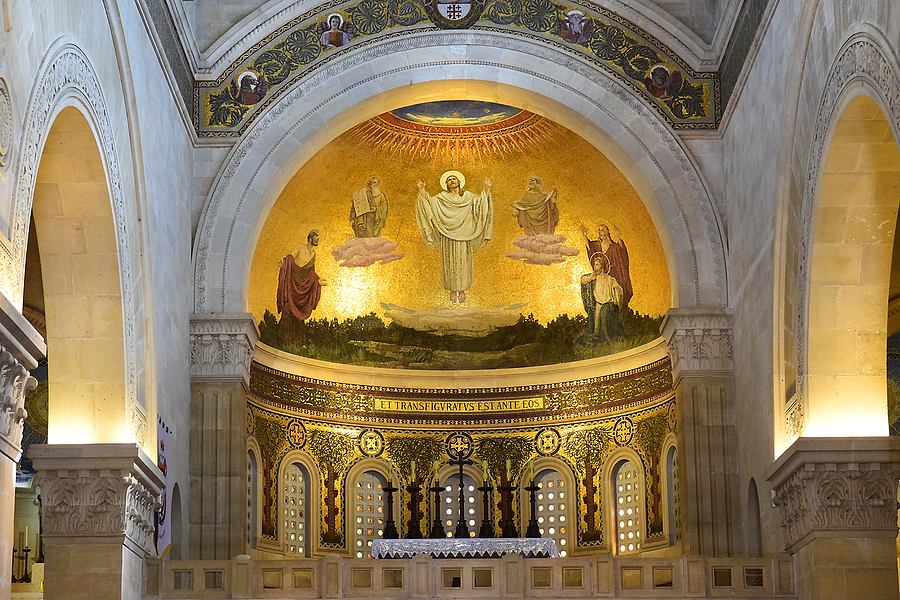
It is good for us to be here: Transfiguration
The Transfiguration is the last miracle performed by Christ, marking the end of his days on earth. Peter, James and John are invited by Christ up to the peak of the mountain to pray. For weeks, he has warned his disciples that the Son of Man will suffer and in three days, rise again.
Imagine it.
Peter has already declared his knowledge that this man Jesus is the Christ, the Messiah.
And so I say to you, you are Peter, and upon this rock I will build my church,* and the gates of the netherworld shall not prevail against it.” I will give you the keys to the kingdom of heaven.* Whatever you bind on earth shall be bound in heaven; and whatever you loose on earth shall be loosed in heaven.”
Shortly thereafter, Jesus predicts his Passion and death:
From that time on, Jesus began to show his disciples that he* must go to Jerusalem and suffer greatly from the elders, the chief priests, and the scribes, and be killed and on the third day be raised.
Then Peter took him aside and began to rebuke him, “God forbid, Lord! No such thing shall ever happen to you.”
He turned and said to Peter, “Get behind me, Satan! You are an obstacle to me. You are thinking not as God does, but as human beings do.”
The phrase sounds vicious. Unless we consider what Jesus, the man, knew and understood. Our Lord is abysmally alone in this knowledge, having failed again and again to help his friends see what only he could see.
For those of us who believe in God, Jesus as God is no problem, but we stumble when we consider Jesus the man.
“…being born in the image and likeness of man, he was known to be of human estate.”
That’s where our minds rebel. Therefore, we focus on Peter when reading and pondering this passage, the man who reminds us of ourselves with his impetuosity. And we wince at the harshness of Christ’s rebuke, not thinking about the feelings which impelled it.
Jesus’s humanity
It is just this humanity that savagely rebukes Peter’s typically hasty, volatile response to Christ. We know that Jesus willed his Passion, this cross. But as we close in on Gethsemane during these forty days of Lent, we can sense the man, his humanity, the awful cost to Jesus through pondering this passage:
“Jesus was no cold Superman, “Romano Guardini writes, ” he was more human than any of us. Entirely pure, unweakened by evil, he was open and loving to the core. His ardor, truth, sensitivity, power, capacity for joy and pain were unlimited, and everything that happened to him happened in the immeasurableness of his divinity. What then must have been Jesus’ suffering!…
Jesus’ will to the Passion is not to be broken, but at the thought of it, his whole frame shudders in the grip of unspeakable pain. We feel it in his furious reply to Peter, when the disciple, well-meaning but puny of heart, tries to dissuade him…”
The will to sacrifice stands fast, but it has been torn from Jesus’ human nature and is throbbingly sensitive; he can bear no tampering with it.”
They accept his invitation:
Jesus took Peter, James, and John his brother,
and led them up a high mountain by themselves.
And he was transfigured before them;
his face shone like the sun
and his clothes became white as light.
And behold, Moses and Elijah appeared to them,
conversing with him.
Then Peter said to Jesus in reply,
“Lord, it is good that we are here.
If you wish, I will make three tents here,
one for you, one for Moses, and one for Elijah.”
While he was still speaking, behold,
a bright cloud cast a shadow over them,
then from the cloud came a voice that said,
“This is my beloved Son, with whom I am well pleased;
listen to him.”
When the disciples heard this, they fell prostrate
and were very much afraid.
But Jesus came and touched them, saying,
“Rise, and do not be afraid.”
And when the disciples raised their eyes,
they saw no one else but Jesus alone.
“It is good for us to be here,” declares the master of understatement, Peter—the most confusing of the twelve apostles. Peter’s public declaration of Christ the Messiah cloaks him in divinity. But with his very next statement, Christ refers to the man who will lead his church as Satan. Peter is a paradox, precisely like you and me.
“It is good for us to be here.”
Yes, Amen, Peter. Jesus loved the simplicity and purity of your heart, your soul, and your mind.
Each year, on the second Sunday of Lent, the Christian church celebrates the Feast of the Transfiguration of Christ. This is our mission, our destiny: To transform and become Him… seeing, feeling, thinking, and loving like Christ. It’s an action we cannot do ourselves, nor is it a one-time event. Rather, our transfiguration is daily, at times, moment by moment.
Every transfiguration begins with painful steps of separation from what is familiar: our family, our home, our land, our possessions, our knowledge, our education, even our good deeds, our prayers, anything and anyone that is good and that we think we might still need and will certainly miss if gone! This comprehensive separation is requested by the bold demands of the Gospel.
Every transfiguration, then, proceeds unevenly, hesitantly, with regrets, second thoughts, relapses and lots of fear. Look at Peter, James and John in our gospel passage. (Matthew 17:1-9)
Every transfiguration requires a high degree of inner freedom. It is the type of pure freedom that enables one, the likes of Abraham and Paul and Mary, and Peter, James and John, to trust unconditionally, blindly, the God who made the initial proposal and who promises to see us to the full realization of our transfiguration.
This is how Paul describes this type of pure inner freedom: “He saved us and called us to a holy life (transfiguration), not according to our works but according to his own design and the grace bestowed on us in Christ Jesus before time began.” (2 Tim. 1:9)
We understand rather easily that we ought to separate ourselves from wrongful things and evil deeds (Jesus’ original message in the Gospel) but should we also “separate” ourselves from our good deeds, our favorite prayers, from all those good things that we do, and from people whom we love dearly?
Aided by the Holy Spirit, we must continue to perform good deeds, and pray well, and do all that our calling in life requires of us as disciples of Christ, however, we cannot count on any of them, because they are the result of God’s infinite, undeserved grace. And nobody but the Lord alone can fill the void in our heart.
Once we are freed of this type of reliance and on non-existent merits, we can place ourselves in the listening mode of total docility to do the Father’s will.
One day, Jesus, the head of the Body, confided a secret to his closest friends: “My food is to do the will of the One who sent me and to finish his work.” (John 4:34)
Not our good work(s) but his! Not our praying but his! Not our will but his!….
Speaking of mission
Last Wednesday’s readings took us back to the Reluctant Prophet, Jonah: The third chapter of the Book of Jonah. We need no reminders to recall the extraordinary lengths Jonah went to elude God, as described in the first two chapters. Instead, we focus on Ninevah’s radical conversion:
The word of the LORD came to Jonah a second time: Set out for the great city of Nineveh, and announce to it the message that I will tell you. So Jonah set out for Nineveh, in accord with the word of the LORD. Now Nineveh was an awesomely great city; it took three days to walk through it. Jonah began his journey through the city, and when he had gone only a single day’s walk, announcing, “Forty days more and Nineveh shall be overthrown,”5the people of Nineveh believed God; they proclaimed a fast and all of them, great and small,* put on sackcloth.
When the news reached the king of Nineveh, he rose from his throne, laid aside his robe, covered himself with sackcloth, and sat in ashes. Then he had this proclaimed throughout Nineveh: “By decree of the king and his nobles, no man or beast, no cattle or sheep, shall taste anything; they shall not eat, nor shall they drink water. Man and beast alike must be covered with sackcloth and call loudly to God; they all must turn from their evil way and from the violence of their hands. “Who knows? God may again repent and turn from his blazing wrath, so that we will not perish.”
When God saw by their actions how they turned from their evil way, he repented of the evil he had threatened to do to them; he did not carry it out.
In his splendid speech to the U.S. Naval Academy, Called Into the Depths, Bishop Robert Barron uses Jonah as a metaphor for human choice. Will we choose egodrama or theodrama?
He begins by explaining what the sea represented to the ancient people: Tohuvavohu or the Hebrew term for confusion, emptiness, and/or chaos:
Now the earth was formless and empty, darkness was over the surface of the deep, and the spirit of God was hovering over the waters.
Genesis1:2
It’s a splendid word for the awfulness of desperate illness, loss, betrayal, unexpected death, and all the horrors implicit in each of our lives, isn’t it? Tohuvavoh
Never are we called only for ourselves, declares Bishop Barron. We know Jonah’s tale well: To some, it is the stuff of kids’ summer Bible camp. Surely not relevant to 2026 or to our individual selves. But to the founder of Word on Fire Ministries, the story of Jonah is your story, his story, and mine. Ongoing and personal.
Jonah was sent alone into the capital city of Assyria: Ninevah. To the Jew, Assyria was enemy territory.
Arise, go to Nineveh, that great city, and cry against it; for their wickedness is come up before me.
The reluctant prophet lives out- in the delicious prose of Bishop Barron, our egodrama or theodrama.
Will we follow our will or the will of God?
Is it a fantasy to hope that the leaders of our age
could rise from their thrones, trade their riches
for truth and atone for the wars they’ve waged?
Is it impossible to think that generations
entrenched in hatred could recognize that
rage only leads to their defeat, then reach
for their enemies’ hands in a gesture of peace?
It is a great gift to be told, “You are going
the wrong way down that slippery road.”
There is a greater one than Jonah in our midst.
Let us not be judged for this; let it be our hope.
Rita A. Simmonds
