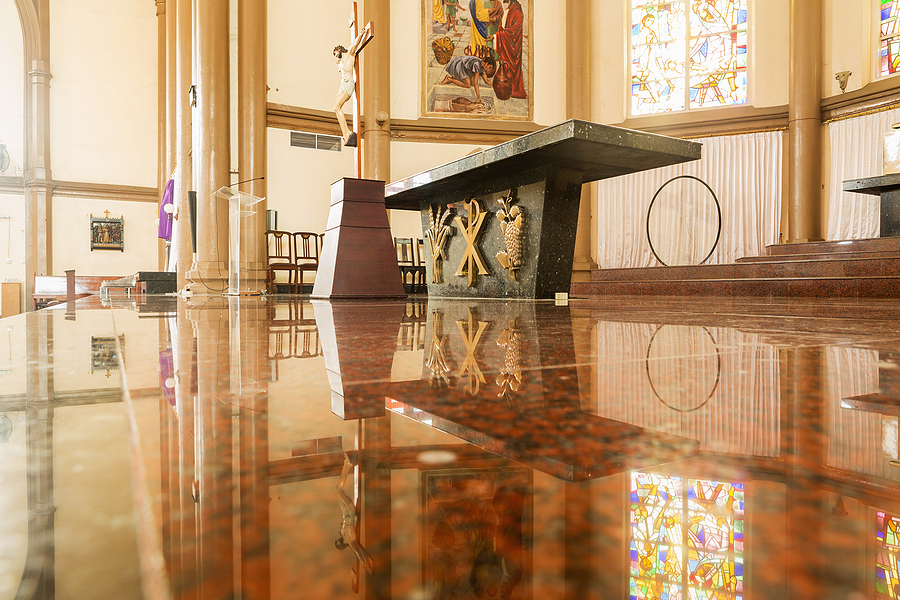
The empty sanctuary of ordinary time.
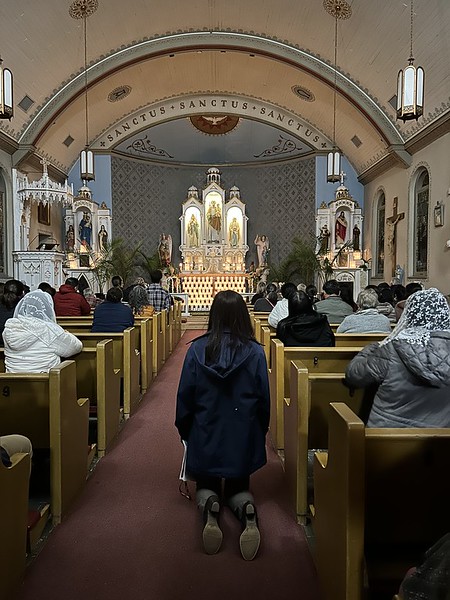
The churches were glorious during this Christmas season. For more than twenty days, the poinsettias stayed vibrant, and outside Saint Matthew’s Church in San Antonio, the soaring tribute to the Triune God became, literally, a tower of light. Now, emptied of Christmas decorations, the empty sanctuaries are stark. The post-Vatican II churches, in the above image, are almost shockingly barren. Less so in the traditional Romanesque or Gothic styles, here at Saint Joseph Honey Creek.
Unlike the endings of previous Christmas seasons, however, I’m not saddened. Indeed, I welcome the starkness and emptiness.
Before this week, I considered the Baptism of Christ as the end of the Christmas Season. However, the Baptism of Christ marks the beginning of the new, and longest, liturgical season: Ordinary Time. The difference this has made in my thinking is huge:
“The feast has ended. It’s time to get back to work!”
Before unpacking the correlation between ordinary time, thoughts, and thorns, we must reframe our perception of the word ordinary. Its root is the Latin word, ordinalis: numbered or ruled…a seasonal rhythm of order: the rhythm of the seasons and the blessing of each new day. Each moment is an opportunity to engage in the ordered sequence with gratitude and open, receptive minds. The green robes of the priests and cloths on our altars signify growth, our growth in the daily routines of living our lives, caring for the creatures and the creation we’ve been given, extending to us the invitation to grow in holiness. Ordinary time begins in winter, so in the northern parts of the world, the leafless trees and plants look dead. We know the roots are there and alive, but the life is dormant. The landscape is stark and empty, like our altars.
Most of us are settling for Bette Midler’s god.
Jesus came from Galilee to John at the Jordan
to be baptized by him.
John tried to prevent him, saying,
“I need to be baptized by you,
and yet you are coming to me?”
Jesus said to him in reply,
“Allow it now, for thus it is fitting for us
to fulfill all righteousness.”
Then he allowed him.
After Jesus was baptized,
he came up from the water and behold,
the heavens were opened for him,
and he saw the Spirit of God descending like a dove
and coming upon him.
And a voice came from the heavens, saying,
“This is my beloved Son, with whom I am well pleased.”
Most of us are settling for Bette Midler’s God was the terrific headline for the first homily given by the newly ordained priest, Father Chris Kanowitz, during a daily Mass at Saint Gall Church in Gardnerville, Nevada. I could not stop thinking about his startling statement while viewing Bishop Robert Barron’s splendid homily for last Sunday’s Feast of the Baptism of Christ. In Side By Side With Sinners, Bishop Barron places us there at the bank of the muddy river Jordan. We see the throngs from all over Israel, Judah, and the Decapolis waiting in line,
And then suddenly Jesus appears. And likely waited in line too, until he stood before the Baptist, who recognized the Lord in awe and horror.
NO!!
I am not fit to tie the laces of your sandals, no!
He who keeps everything in being, the creator of the universe, asks to be baptised.
This is no God watching us from a distance like the Bette Midler song. This is Jesus who was sent by the Father to wallow in the mire of our hearts, minds, and corrupted world. Closer to us than we are to ourselves, this lover risks everything for your soul and mine.
Everything matters, even-maybe especially, our thoughts
Evil begins in our thoughts and hearts. The Empty Sanctuary of Ordinary Time: Thoughts and Thorns.
My child, Courage, do not miss anything of what I suffered. Be attentive to My Teachings. I have to redo man in everything. Sin has removed
the crown from him, and has crowned him with opprobrium and with confusion; so he cannot stand before My Majesty. Sin has dishonored him, making him lose any right to honors and to glory. This is why I want to be crowned with thorns—to place the crown on man’s forehead, and to return to him all rights to every honor and glory. Before My Father,
My thorns will be Reparations and voices of defense for many sins of thought, especially pride; and for each created mind they will be voices of Light and supplication, that they may not offend Me. Therefore, unite yourself to Me, and pray and repair together with Me.”
Years ago, in a class of thirty or so people, the Wharton professor asked for a volunteer to leave the room. After the door closed behind her, we were instructed to say and think like this about the woman outside the room:
“Alice is beautiful.”
“She is a wonderful person,”
“Alice is trustworthy.”
When she returned, Dr. Phil instructed her to extend and hold her arm steady while he attempted to lower it. Despite his being several inches taller and fifity or sixty pounds heavier, he could not budge her arm.
Then he asked her to leave the room. This time, we were all instructed to think thoughts like, “What a jerk, she is!”
“I cannot stand that woman!”
“She’s ugly and stupid!”
When Dr. Phil repeated the experiment, Alice’s arm dropped like a stone. She could not resist his pressure.
Our gossip, criticism, negativity, and anger have incalculable consequences.
But we can choose another attitude:
It’s time to give love a chance – then peace will join us at the table for celebration.
Doc Childre, Founder of HeartMath Institute and HeartMath Inc.
The year is still new:
Each moment of each day presents us with a choice. What do we do with the most powerful force on earth? I write not about hurricanes, wars, or earthquakes, but the human will. Of all of creation, the universe and its stars, suns, earth and its creatures, only you and I can choose to disobey God.
We are different from what we were last year. Through our thoughts and actions, we have either become closer to Jesus or distanced ourselves by doing what we know is wrong. Or our refusal to accept what the Will has placed before us. Our withdrawal from our pain or that of those we love is instinctive. Our shock at a sudden, devastating illness, betrayal or loss makes us cringe, cower, and want to flee:
WHY LORD?
He is a sign of contradiction, this Jesus. He confused most of the powers around him: Herod, Pilate, the religious authorities. Only the desperate understood who he was.
If you wish, you can make me clean
I do wish it, be made clean.
Choosing to Follow
As with so much in our life, we have to choose again and again. The choice we make this year will be a little bit different from the choice we made last year—because we are changing and our involvement in our way of life is changing. And each time we choose, we become more and more the person God is calling us to be.
In a sense there are in every vocation two Follow me’s: the initial one, which was marked by a certain urgencyand generosity, and another, at the hour of discouragement, difficulty, trial. Saint Peter himself knew these two Follow me’s. And his life shows us that the hour when the following of Christ was even more difficult, the moment even of his denial, was not a moment of giving up. It was for him the moment of a new maturity, the moment when he determined to follow Jesus even to the end in love. We see this after the Passion in Galilee (the scene of the first call) when the risen Lord asks him the ultimate question:Do you love me more than anything? More than your own feelings, your own happiness? And from the lips of Peter comes the most beautiful declaration of love, a cry of love welling up from a heart that has known suffering: Lord, you know everything, you know that I love you. And Jesus says to him a second time:
Follow me. So too, in our lives, there’s always a second Follow me—and it comes at the hour of trial. Despite appearances, this hour never prevents us from loving or being faithful.It is, in truth, the hour of maturing in love and fidelity, the hour of the definitive Follow me.
Love of God is not something that can be taught….As soon as the living creature (that is, man) comes to be, a power of reason is implanted in us like a seed, containing the ability and the need to love. When the school of God’s law admits this power of reason, it cultivates it diligently, skillfully nurtures it, and with God’s help brings it to perfection….”
From the Detailed Rules for Monks by Saint Basil the Great

2 thoughts on “The Empty Sanctuary of Ordinary Time: Thoughts and Thorns”
Thank you for another thoughtful and spirit filled writing. I love it🙏❤️
Thank you for taking the time to write.