Know thyself: gnōthi seauton:
These two words were inscribed in the vestibule of the Temple of Apollo in Delphi. They were the reason Socrates disputed the Oracle’s declaration that he was the wisest person on earth. When told what the Oracle had said, Socrates demurred, insisting that since he did not know himself, he could not be wise, never mind be the wisest on earth.
A million years ago, as an undergrad, I fell in love with the idea behind the phrase, ‘know thyself,’ the love of wisdom personified by Socrates, Plato, Aristotle, in short, that ancient, rarified Greek air. It rekindled when I made a trip there, alone, a few decades later. Alone in Delphi in the late nineties, I stood in the ruins of the Oracle at Delphi thinking about her admonition to all seekers: Gnōthi Seauton: ‘Know Thyself’.
Plato declared in his Apology, ‘The unexamined life is not worth living.’
And close to two thousand years later, Thoreau wrote,
“It is not enough to be busy. The ants are busy. The question is: What are we busy about?
We live in an age
where we click or tap to find the answer to everything. We believe we’re logical decision makers,, using our reason to sift through the information, analyse it and form opinions, and make decisions. Decision-making theory fascinated me ever since I knew it existed.
My early years were spent in critical care nursing. And then later, administration in academic medicine. Both are fields where decisions can be matters of life or death. For over three decades, I worked with physicians. These men and women are ostensibly at the top of the heap of human rationality and perceived as the quintessence of reason. But the truth is that doctors are no more, and at times, are far less “rational” than non-physicians. Frequently, their medical decisions are based on emotion-ego, rather than data or even facts.
Just like the rest of us.
While working on my doctorate, I discovered the Nobel Prize-winning Garbage Can Model of Decision-Making developed by Cohen, March, and Olsen. The researchers confirmed my experience of chaotic and frequently irrational decision-making by top health-care administrators. and physicians.
More recently. “Seeing Truth in the Age of Information Overload” caught my attention. The author uses the recent controversy over vaccinating newborns against Hepatitis B to illustrate that
…much of the medical profession is so invested in their way of seeing the world that they simply cannot see things which directly contradict it. Because of this, the (extremely rare) case of hepatitis B being contracted in unvaccinated children filled their entire mental focus, while conversely, the far more common (and frequently far more severe) injuries from the vaccines passed through one ear and out the other, and were all reflexively written off under the notion “no controlled studies demonstrate this, so that’s proof it’s not happening”—despite the fact controlled studies of vaccines are explicitly prohibited due to them being “unethical.”
Several years ago, I ‘met’ Dan Ariely.
He asks the same questions the ancient Greeks did. But formats them in the 21st-century academic language of behavioral economics. An iconoclast, Dan studies our facades, takes well-established beliefs, and blows them up. For example, cheating, irrationality, and lying are done only by those lacking education and upbringing. We’re often happy, sometimes ecstatic, to read about the cheating, irrationality, and lying done by others. But that’s not what Dan talks about. He’s after the lying, cheating and lying done by you and me.
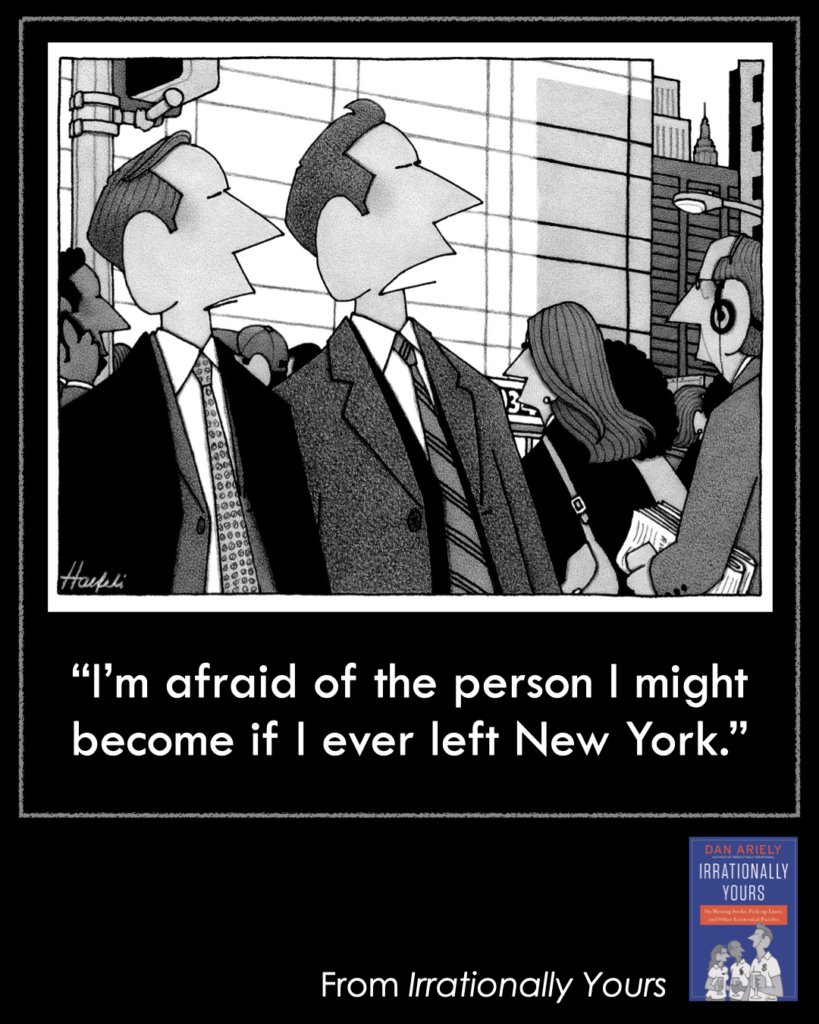
Dan’s TED talks: brief, gripping and provocative. He begins each one with the story of why he became interested in these subjects while a burn patient due to an explosion causing burns over 70% of his body.
Eric Barker asked Dan if creative people were more dishonest:
“So think about what we find about dishonesty. What we find is it’s a struggle between two forces. You want to think of yourself as an honest, wonderful person on one hand and you want to gain from dishonesty on the other hand. And the way you can do it is to tell yourself a story about why this is actually okay. So ask yourself who can tell better stories? It turns out more creative people can tell better stories, so that’s actually what we find. We find it when we measure students that are more creative, they cheat more. We find that when we use priming to increase creativity, we also increase dishonesty. And when we went to an advertising agency, we also found that the people in the advertising agency who were in more creative job titles also had more flexibility.”
“A struggle between two forces,” indeed.
…With these thorns I want to
shatter the spirit of pride of their lordships; and with the holes that they form in My Head, I
want to open My way into their minds, in order to reorder all things in them, according to
the Light of Truth. By remaining so humiliated before this unjust judge, I want to make
everyone understand that only virtue is what constitutes man king of himself; and I teach to
those who command, that virtue alone, united to upright knowledge, is worthy and capable
of governing and ruling others, while all other dignities, without virtue, are dangerous and
deplorable things.
